感謝新加坡管理大學朱飛達教授的邀請,網絡社會研究所能夠以特別策劃的形式加入 SMU Web3 Week (Nov. 27-30)的學術活動。年會特別場包含論壇與展覽,集中在 Nov. 28-29 日 。
將臨的網絡:互為勞動與社會的重組
The Network to Come: Inter-Labor and the Recomposition of the Social
時間
2025年11月28-29日
(週五至週六)
地點
新加坡管理大學
The Ngee Ann Kongsi Auditorium, SoA, SMU
主辦單位
新加坡管理大學計算與信息系統學院
協辦與支持
中國美術學院跨媒體藝術學院(SIMA)
網絡社會研究所(INS)
開放媒體系(OM Dept)
Prestige Gallery(新加坡)
會議總召
朱飛達 教授(新加坡管理大學 信息系統學院副院長)
黃孫權 教授(中國美術學院 網絡社會研究所所長)
引言
繼上海舉辦的第十屆網絡社會年會——「互聯的終結?愛(AI)來不來?」之後,新加坡場次將目光轉向那個被宣告存在於互聯網終結之後的世界。此次活動新加坡管理大學計算與信息系統學院主辦,由中國美術學院網絡社會研究所合辦,並得到 Prestige Art Gallery 的慷慨支持。我們非常高興的可以成為 SMU Web3 Week 的特別活動之一。
上海場標誌著一個轉折點:我們意識到,曾經作為「開放」之隱喻的網絡,已然變成了平臺時代私有化和企業化的數據基礎設施。新加坡場從這種疲憊中出發——可以說是翻過這一頁——去思考在互聯網的殘餘之中,新的勞動、關係和想象形式正如何悄然重組。我們提出(或許略顯魯莽地)一段名為「互為勞動」(Inter-labor)的理論旅行。
「互為勞動」指涉一種由三個相互交織的過程所構成的新歷史條件。
首先,AI 並非外星的發明,而是人類集體的創造:每一個模型、數據集和參數都凝聚了人類推理、翻譯、標註和想像的漫長曆史。
其次,今天的人類與 AI 確實在一起工作,但這並非「共存」的和諧二重奏。相反,它們的關係形成了一種建模、提示、驗證與維護的不平衡生態——機器的輸出成為了隨後人類工作的素材與約束。這既不是設計師想像中的「人機介面」,也不是「共生」這般未經批判的口號。
第三,也是最關鍵的一點,人類正日益「通過」AI 與彼此協作。這種由算法中介的互為勞動正在重構「社會」(The Social),並極有可能成為下一個「網絡」的決定性特徵。
AI 並未解放勞動,它重新分配了勞動。它讓隱形勞動增殖,精煉可提取之物,並將注意力本身轉化為新的基礎設施。我們深知,每一個模型本質上都是集體勞動的記錄——一個由清洗、權重、標註、修正和沉默所構建的語料庫,全部被摺疊進黑箱計算之中。AI 所謂的「智能」,實則是人類勞動的沉積物(sediment),是眾多人類經由代碼折射後的迴響。談論互為勞動,即是確認一種新的歷史性:人類創造了一種鏡像自身智能的機器——但它反映的不是個體,而是一個通過技術學習自身的社會身體。
在互為勞動中,「社會性」浮現了。人類不再僅僅是與 AI 一同工作,而是通過它工作。在此條件下,作者權、價值和照料(care)的邊界變得模糊:隱形勞動支撐著可見的創造,算法秩序重寫了價值的度量。由人創造、向人學習的 AI,反過來重寫了人類共存的根本條件。
在此視角下,藝術重獲了一種核心可能性。本世紀以來,藝術過多地臣服於技術決定論或政治正確的論述——被對技術錯誤和政治錯誤的雙重恐懼所糾纏。然而,藝術仍是一種獨特的人類遭遇世界的方法。它可以使交互勞動的肌理可見——展現其延遲、摩擦和偏差;它可以排演「反基礎設施」(counter-infrastructures)——如民間檔案、合成方言、慢計算;它可以預演新的團結與照料形式。
如果每一次計算都是一種構成(composition),那麼策展、編碼和組織就成為了「世界營造」(world-making)的技術。互聯網(inter-net)之後是互為勞動的網絡——一個不再以速度或規模衡量,而是以其「共同構成感知與記憶之脆弱關係」的能力來衡量的網絡。因為人類當下正面臨失去「世界營造」勞動本身的風險——我們失去的不是其基礎,而是文化與慾望藉以生成的運動本身。(文/黃孫權教授)
會議內容
11月28日(論壇): 將彙集理論家、藝術家和技術研究者,共同探索這一轉型——從不可見勞動的經濟學到算法的詩學,從雲基礎設施的地緣政治到共享能動性的藝術實踐。
11月29日(放映與展覽): 上午10點,Dylan 的影片《互聯網的終結》(The End of Internet)放映,以此呼應上海場的主題;下午3點,展覽《共誤:互為勞動時代下的藝術》(Shared Errors: Art in the Age of Inter-Labor)將在 Prestige Gallery 開幕。本次展覽由黃孫權教授策展,與中國美術學院跨媒體藝術學院開放媒體系師生合作完成。這場展覽不是理論的補充,而是理論的試驗場:通過數據、技術和感知的重構,藝術家們揭示了錯誤、延遲和重複如何成為新的認識論形式。在這裡,藝術不回應技術,也不崇拜技術——它將技術揭示為一種當代社會經驗的形式。
The Network to Come: Inter-Labor and the Recomposition of the Social
November 28–29, 2025, Singapore
Convener:
Prof. ZHU Feida, Associate Dean of School of Information Systems, SMU
Prof. HUANG Sunquan, Director of Institute of Network Society. China Academy of Art
Host by
School of Computing & Information Systems, Singapore Management University
Co-organized by
Institute of Network Society & Department of Open Media, School of Intermedia Art, China Academy of Art
Prestige Gallery, Singapore
By Prof. HUANG Sunquan
Following the 10th Annual Conference of Network Society in Shanghai—”The End of Connection? AI (Love) Coming or Not?”—the Singapore edition, co-organized by the Institute of Network Society, School of Intermedia Art, China Academy of Art, and the School of Computing and Information Systems, Singapore Management University, with generous support from Prestige Art Gallery, turns its gaze toward the world declared to exist after the end of the internet.
Shanghai marked a turning point: we realized that the network, once a metaphor of openness, has become the privatized and corporatized data infrastructure of the platform age. Singapore departs from this exhaustion—turning the page, as it were — to consider how, amid the residues of the internet, new forms of labor, relation, and imagination are quietly reassembling. We propose, perhaps recklessly, a new theoretical journey under the name inter-labor.
Inter-labor designates a new historical condition composed of three intertwined processes.
First, AI is not an alien invention but a collective human one: every model, dataset, and parameter condenses the long history of human reasoning, translation, annotation, and imagination.
Second, humans and AI do indeed work together today, but not as a harmonious dyad of “coexistence.” Rather, their relation forms an uneven ecology of modeling, prompting, verification, and maintenance — where mechanic outputs become both the material and the constraint of subsequent human work. This is neither the “human-machine interface” imagined by designers, nor the uncritical slogan of “symbiosis.”
Third, and most crucially, humans increasingly work with one another through AI. This algorithmically mediated inter-labor is reconfiguring the social, and may well become the defining feature of the next network to come.
AI does not liberate labor; it redistributes it. It proliferates the invisible, refines what can be extracted, and converts attention itself into a new infrastructure. We know that every model is, in truth, a record of collective work—a corpus built from cleaning, weighting, labeling, correction, and silence, all folded into black-box computation. The so-called “intelligence” of AI is the sediment of human labor, the echo of the many refracted through code. To speak of inter-labor is thus to recognize a new historicity: humanity has created a machine that mirrors its own intelligence—yet one that reflects not individuals, but a social body learning itself through technology.
Within inter-labor, “The Social” emerges.Humans no longer merely work
with AI, but through it. Under these conditions, the boundaries of authorship, value, and care blur: invisible labor sustains visible creation, and algorithmic order rewrites the measure of worth. AI — created by humans, learning from humans—has in turn rewritten the very conditions of human coexistence.
From this vantage, art regains a kind of core possibility. Since the beginning of this century, art has too often submitted to the discourses of technological determinism or political correctness — haunted by the fear of technical error and the fear of political error alike. Yet art remains a distinct human method of encountering the world. It can render visible the textures of inter-labor—its delays, frictions, and deviations; it can rehearse counter-nfrastructures — folk archives, synthetic dialects, slow computation; and it can prefigure new solidarities and forms of care.
If every computation is also a composition, then curating, coding, and organizing become techniques for world-making. After the inter-net comes the inter-labor network—a network that may no longer be measured by speed or scale, but by its capacity to co-compose the fragile relations of perception and memory. For humanity now stands at risk of losing the labor of world-making itself—not its foundation, but the very movement through which culture and desire have always come into being.
On November 28, the Forum will bring together theorists, artists, and researchers in technology to explore this transformation—from the economies of invisible labor to the poetics of algorithms, from the geopolitics of cloud infrastructures to artistic practices of shared agency.
On November 29, we will screen Dylan’s Film “ The End of the Internet” at 10 am,and the exhibition “Shared Errors: Art in the Age of Inter-Labor” opens at 15:00 at Prestige Gallery. Curated by Huang SunQuan, in collaboration with the faculty of the Open Media Department, School of Intermedia Art, China Academy of Art
, This exhibition is not a supplement to theory but its trial ground: through reconfigurations of data, technology, and perception, artists reveal how error, delay, and repetition can become new epistemic forms. Art here does not respond to technology, nor worship it — it exposes technology as a contemporary form of social experience.
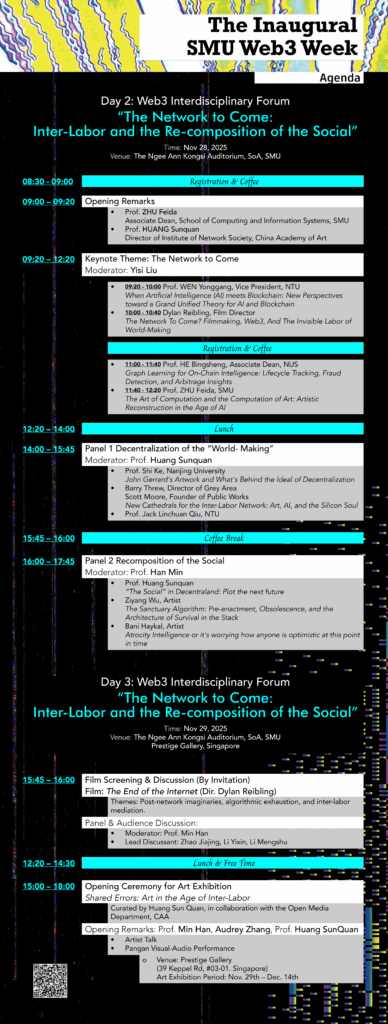
會議日程(年會部分)
工作團隊
會議組
黃孫權|劉懌斯|
周蓬岸|李夢書|趙佳菁|李藝欣
策展組
黃孫權 | 蔡宇瀟|武子楊|曹澍|闞梓菡|錢可奕
本體論維度 / Ontological Dimensions