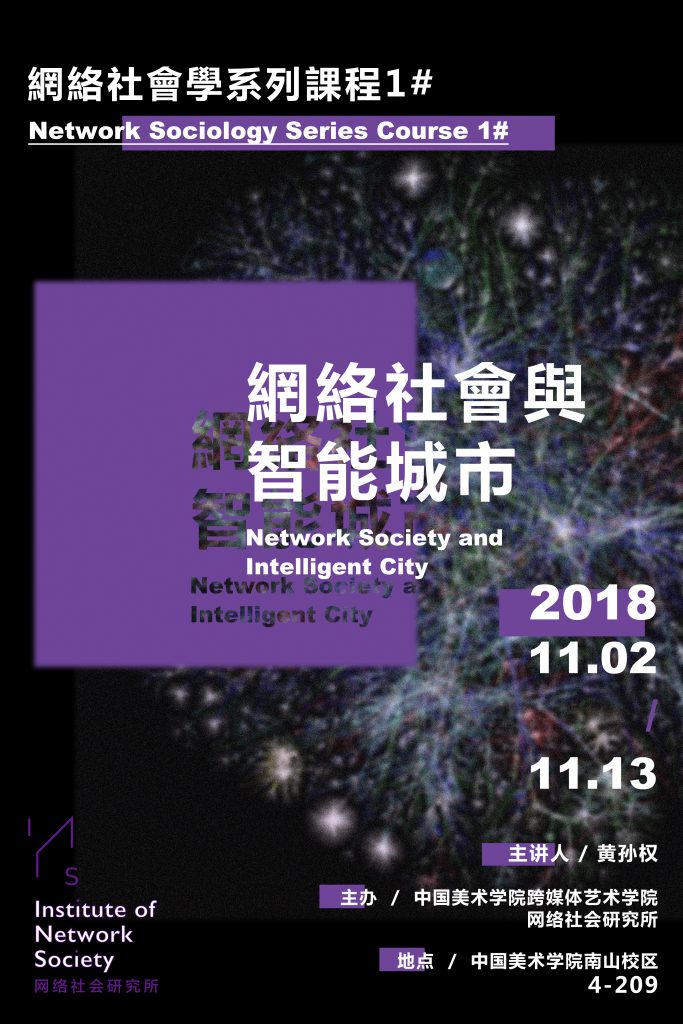
此係列課程是為了建立網絡社會學研究之基礎,也是面對未來”平臺社會”的理論實踐之預習。預計規劃六次系列:網絡社會的崛起與智能城市;認同的力量;從文化研究到軟體研究;黑客文化與新;空間政治─演算學;平臺社會。綜合演講課、討論課進行,課後紀要可出版具深度反思的網絡社會學讀本。
首次短課程目的有二:一是培養參與第三次網絡社會年會”智慧城網“討論的理論準備;二來能夠深化發展淘寶村初期研究與撰寫。以討論課(seminar)形式展開。參與同學必須投入文本閱讀與報告,整理課程演講與討論紀要。讀本以Manuel Castells的網絡社會學三部曲首部為主,延伸重要的閱讀與參考書目。
關鍵詞:馬克思主義的城市研究 網絡社會 網絡國家 網絡經濟 網絡勞工 智能城市 都市網絡 淘寶村
一、導論:我們需要什麼樣的網絡社會學?
11/2 pm 7~9
required
- Susser, Ida (2002) “Manuel Castells: Conceptualizing the City in the Information Age”, in Ida Susser ed.Cities and Social Theory, Oxford: Blackwell, pp.1-12.(中譯,二十一世紀的都市社會學,城市設計學報);2017年新美術。
- 薩斯基婭·薩森:21世紀的新都市中心性
- 黃孫權:我們需要什麼樣的網絡社會研究, 2017新美術
recommand
- Saskia Sassen:重返國族國家| 摘要| 訪談全文
- Doren Massey, JOhn Allen, Steve Pile edited. 認識城市第一冊:城市世界,(understanding cities vol.1 city worlds),2009,臺北:羣學出版社(三冊都很精采)
- 夏鑄九:網絡社會與信息化城市 講座系列 https://www.caa-ins.org/archives/141
二、基礎:馬克思主義的城市研究
11/4 pm 7~9
required
- Manuel Castells, “afterword 1975”, in The urban Question: A Marxist Apporach, p437-471(有中譯)
- Manuel Castells,(1983)”A Cross-Culture Theory of Urban Social Change”, in The City and the Grassroots, Cal: University of California Press. Pp.289-336(有中譯,陳梧譯,〈一個跨文化的都市社會變遷理論〉,收於夏鑄九、王志宏編譯,《空間的文化形式與社會理論讀本》,pp.223- 300 ,臺北:明文書局)
- Manuel Castells,(1983)”General Methodogical Issues”, in The City and the Grassroots, Cal: University of California Press. Pp.339-343.(有中譯)
recommand
- Ira katznelson (1993) “Marxism and the City?” in Marxism and the City. pp.1-42
- Allen J. Scott(1982) 〈社會的空間基礎之論述的意義社會起源〉, 空間的文化形式與社會理論讀本。pp1-18.
- Manuel Castells & Marti Ince(2004), Conversations with Manuel Castells, Polity
三、網絡社會崛起:IT產業,全球化與網絡經濟興起
11/7 pm 2~5
required
- ManuelCastells, “prologus: the net and the self”, The rise of Network Society. p1-25 (有中譯)
- Maneul Castells, 1,2,3 chapter in The rise of Network Society. p28-215(有中譯)
recommand
- Castells, M. (2000). Toward a Sociology of the Network Society. Contemporary Sociology, 29(5), 693. doi:10.2307/2655234
- Castells, M. (2002). Local and Global: Cities in the Network Society. Tijdschrift Voor Economische En Sociale Geografie, 93(5), 548–558. doi:10.1111/1467-9663.00225
- 邱林川(2015),信息時代的世界工廠
- 沃勒斯坦(2013),現代世界體系(全四卷)
- 沃勒斯坦(2003), 所知世界的終結:二十一世紀的社會科學
- 陳東昇(2008), 積體網路:臺灣高科技產業的社會學分析(增訂版)
- Saskia Sassen(2001), The global city.
四、網絡社會崛起:工作、文化、流動空間與無時間的時間
11/9 pm 7~9
required
- Manuel Castells(2000), chapter 4,5,6, conclusiion, The rise of Network Society.
- Manuel Castells(1989) ,”Conclusion:The Reconstruction of social meaing in the space of flows”, The Information city: Information technology, economic Resturcturing and the urban-regional process, Blackwell, pp348-53(有中譯)
recommand
- 邱林川 (2016) ,工人階級網絡社會
- 韓炳哲(2015), 倦怠社會, 臺北:大塊文化
- Nick SRNICEK(2015), Inventing the Future: Postcapitalism and a World Without Work, Verso
五、智能城市
11/11,13 pm 2~5
required
- Shelton, T., Zook, M., & Wiig, A. (2014). The “actually existing smart city.” Cambridge Journal of Regions, Economy and Society, 8(1), 13–25. doi:10.1093/cjres/rsu026
- Hollands, R. G. (2014). Critical interventions into the corporate smart city. Cambridge Journal of Regions, Economy and Society, 8(1), 61–77. doi:10.1093/cjres/rsu011
- Rama Krishna Reddy Kummithaa, Nathalie Crutzen(2017), ”How do we understand smart cities? An evolutionary perspective”,Cities 67:43-52
recommand
- Andrea Caragliu, Chiara Del Bo & Peter Nijkamp (2011): Smart Cities in Europe, Journal of Urban Technology, 18:2, 65-82
- Chourabi, H., Nam, T., Walker, S., Gil-Garcia, J. R., Mellouli, S., Nahon, K., … Scholl, H. J. (2012). Understanding Smart Cities: An Integrative Framework. 2012 45th Hawaii International Conference on System Sciences. doi:10.1109/hicss.2012.615
- Adam Greenfield, Againsgt the Smart City
- Mark Shepard edited (2011), Sentient City Ubiquitous Computing, Architecture, and the Future of Urban Space, MIT press
- Paskaleva, K. A. (2011). The smart city: A nexus for open innovation? Intelligent Buildings International, 3(3), 153–171. doi:10.1080/17508975.2011.586672
case study
- sidewalk project
- 城市大腦
- 馬來西亞城市大腦
- 臺北智慧城市
- 國際智慧社區論壇
- 倫敦智慧城市 Citymapper Transit Navigation ,medium上的專頁)
- 芝加哥的AOT
- 聯合國的智慧城市夥伴
- 新加坡的聰明國度
- 韓國智慧城市
- 臺北智慧城市與物聯網計劃
六、第一階段淘寶村研究寫作計劃
11/1 下午2~5 寫作討論一
11/8 下午2~5 寫作討論二
11/12下午2~5 寫作討論三
本體論維度 / Ontological Dimensions