學術引用 Citation
李墨、小孔(2014)。展出與權宜:「無地之愛」黃孫權個展評述。藝術界 LEAP,總第155期,2014年11/12月號,頁58-61。 Li Mo & Kong (2014). Exhibition and Expediency: "U-topophilia": Huang Sun Quan Solo Exhibition. LEAP: The International Art Magazine of Contemporary China, No. 155, Nov/Dec 2014, pp. 58-61.
原始刊物頁面
他們觸及到一個問題,由於假定自己已經解決了問題,他們就為它的真正解決設下了障礙。 "They had touched on a problem, and by supposing they had solved it they had created a hindrance to its solution." ——尼采《朝霞》 / Friedrich Nietzsche, The Dawn
中文
文/李墨、小孔
在「無地之愛」展覽中,黃孫權提出對地點、建築、烏托邦與社會運動的敘事策略,以及它們在社會性空間中相互聯結的可能。所展出的四件作品,揭示出藝術行動者如何從創作者的主體,轉變成與田野成為共同生產者的團體協作過程——從對具體地點之愛到無地之愛。這些作品可以分為兩組:《出櫃》為一組,《我們家在康樂里》、《日常生活的一天》、「複島」系列為另一組。
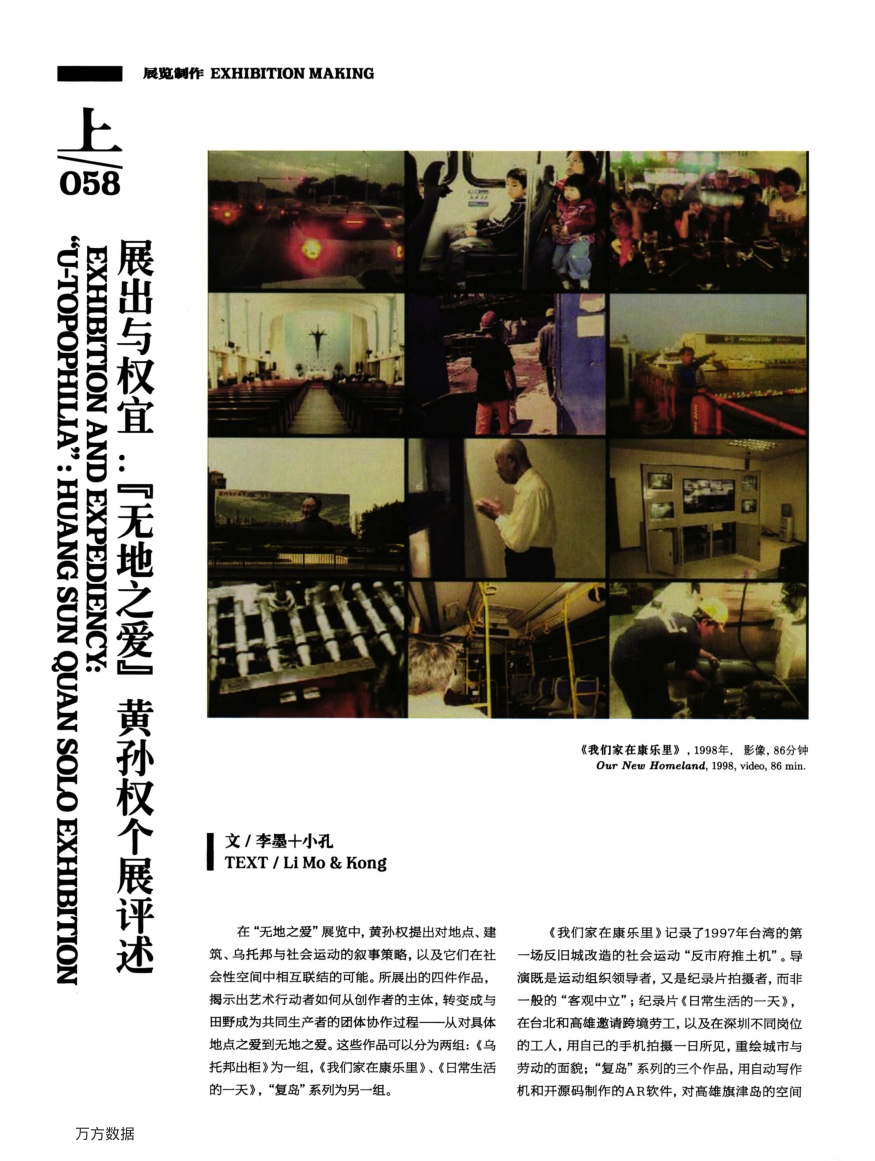
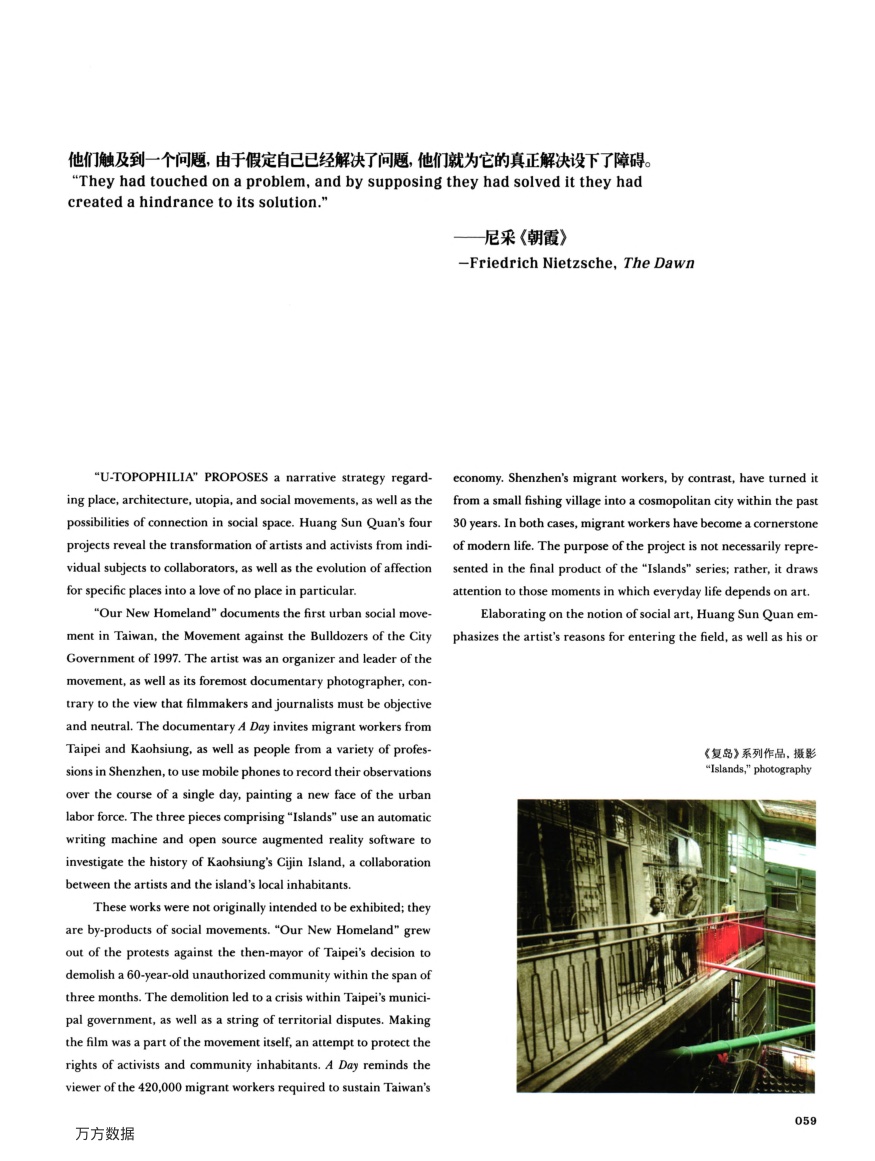
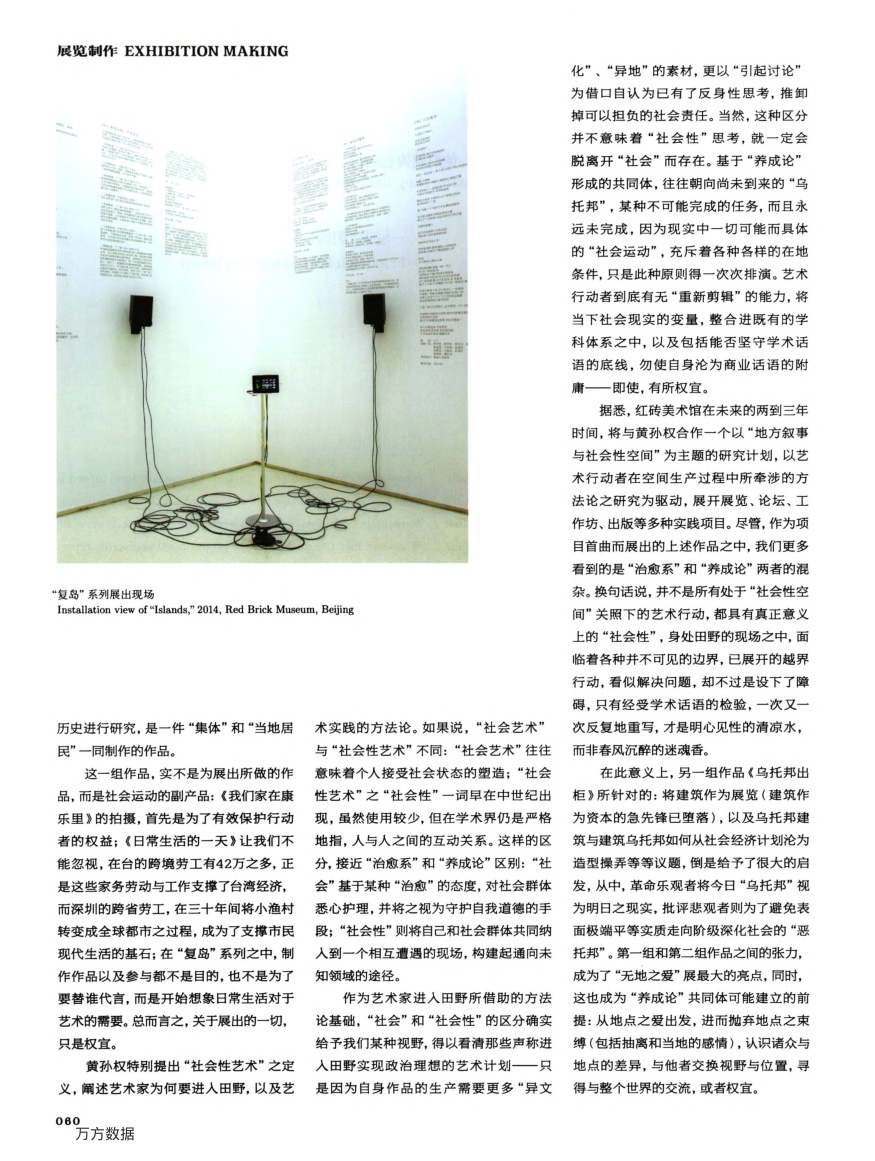
《我們家在康樂里》記錄了1997年臺灣的第一場反舊城改造的社會運動「反市府推土機」。導演既是運動組織領導者,又是紀錄片拍攝者,而非一般的「客觀中立」;紀錄片《日常生活的一天》在臺北和高雄邀請跨境勞工,以及在深圳不同崗位的工人,用自己的手機拍攝一日所見,重繪城市與勞動的面貌;「複島」系列的三個作品,用自動寫作機和開源碼製作的AR軟體,對高雄旗津島的空間歷史進行研究,是一件「集體」和「當地居民」一同製作的作品。
這一組作品,實不是為展出所做的作品,而是社會運動的副產品:《我們家在康樂里》的拍攝,首先是為了有效保護行動者的權益;《日常生活的一天》讓我們不能忽視,在臺的跨境勞工有42萬之多,正是這些家務勞動與工作支撐了臺灣經濟,而深圳的跨省勞工,在三十年間將小漁村轉變成全球都市之過程,成為了支撐市民現代生活的基石;在「複島」系列之中,製作作品以及參與都不是目的,也不是為了要替誰代言,而是開始想像日常生活對於藝術的需要。總而言之,關於展出的一切,只是權宜。
黃孫權特別提出「Societal Art」之定義,闡述藝術家為何要進入田野,以及藝術實踐的方法論。如果說,「社會藝術」與「Societal Art」不同:「社會藝術」往往意味著個人接受社會狀態的塑造;「Societal Art」之「社會性」一詞早在中世紀出現,雖然使用較少,但在學術界仍是嚴格地指,人與人之間的互動關係。這樣的區分,接近「治癒系」和「養成論」區別:「社會」基於某種「治癒」的態度,對社會群體悉心護理,並將之視為守護自我道德的手段;「社會性」則將自己和社會群體共同納入到一個相互遭遇的現場,構建起通向未知領域的途徑。
作為藝術家進入田野所借助的方法論基礎,「社會」和「社會性」的區分確實給予我們某種視野,得以看清那些聲稱進入田野實現政治理想的藝術計畫——只是因為自身作品的生產需要更多「異文化」、「異地」的素材,更以「引起討論」為借口自認為已有了反身性思考,推卸掉可以擔負的社會責任。當然,這種區分並不意味著「社會性」思考,就一定會脫離開「社會」而存在。基於「養成論」形成的共同體,往往朝向尚未到來的「烏托邦」,某種不可能完成的任務,而且永遠未完成,因為現實中一切可能而具體的「社會運動」,充斥著各種各樣的在地條件,只是此種原則得一次次排演。藝術行動者到底有無「重新剪輯」的能力,將當下社會現實的變量,整合進既有的學科體系之中,以及包括能否堅守學術話語的底線,勿使自身淪為商業話語的附庸——即使,有所權宜。
據悉,紅磚美術館在未來的兩到三年時間,將與黃孫權合作一個以「地方敘事與社會性空間」為主題的研究計畫,以藝術行動者在空間生產過程中所牽涉的方法論之研究為驅動,展開展覽、論壇、工作坊、出版等多種實踐項目。儘管,作為項目首曲而展出的上述作品之中,我們更多看到的是「治癒系」和「養成論」兩者的混雜。換句話說,並不是所有處於「社會性空間」關照下的藝術行動,都具有真正意義上的「社會性」,身處田野的現場之中,面臨著各種並不可見的邊界,已展開的越界行動,看似解決問題,卻不過是設下了障礙,只有經受學術話語的檢驗,一次又一次反覆地重寫,才是明心見性的清涼水,而非春風沉醉的迷魂香。
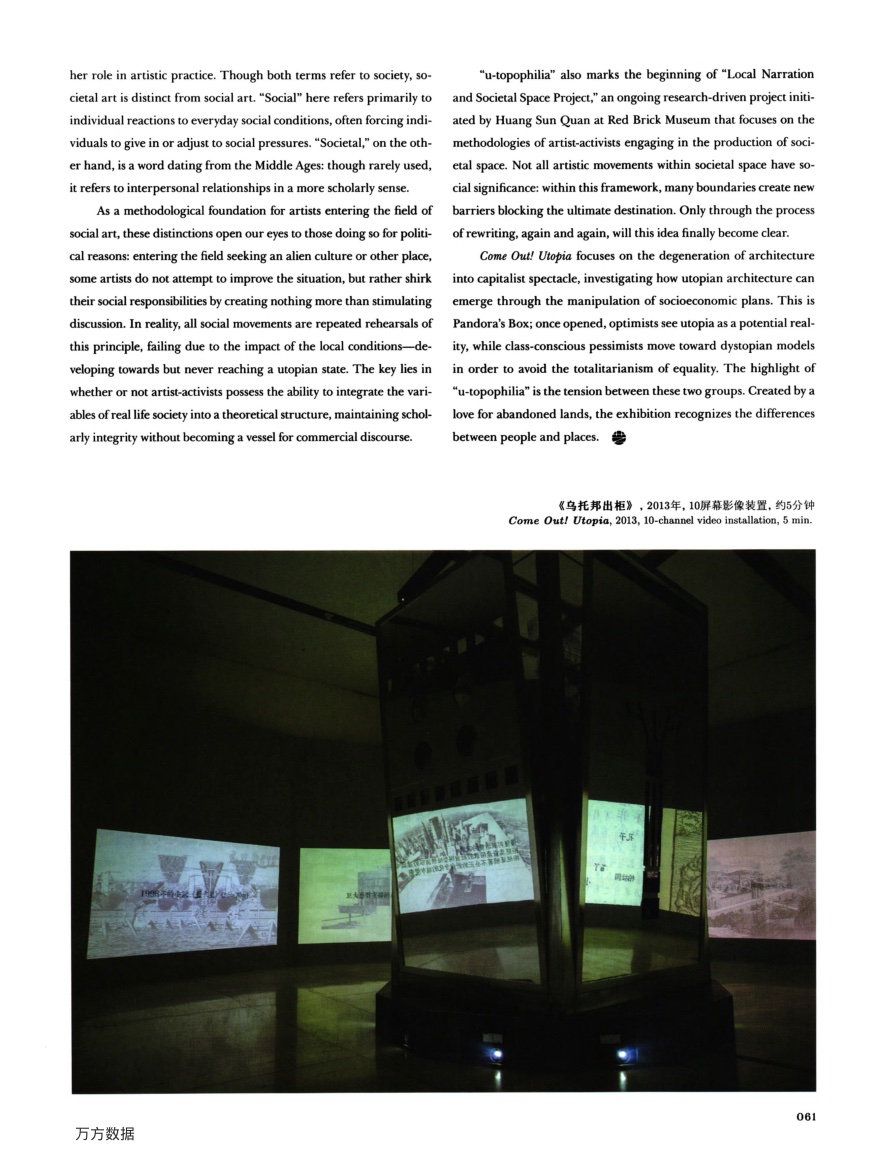
在此意義上,另一組作品《出櫃》所針對的:將建築作為展覽(建築作為資本的急先鋒已墮落),以及烏托邦建築與建築烏托邦如何從社會經濟計畫淪為造型操弄等等議題,倒是給予了很大的啟發,從中,革命樂觀者將今日「烏托邦」視為明日之現實,批評悲觀者則為了避免表面極端平等實質走向階級深化社會的「惡托邦」。第一組和第二組作品之間的張力,成為了「無地之愛」展最大的亮點,同時,這也成為「養成論」共同體可能建立的前提:從地點之愛出發,進而拋棄地點之束縛(包括抽離和當地的感情),認識諸眾與地點的差異,與他者交換視野與位置,尋得與整個世界的交流,或者權宜。
English
"U-topophilia" proposes a narrative strategy regarding place, architecture, utopia, and social movements, as well as the possibilities of connection in social space. Huang Sun Quan's four projects reveal the transformation of artists and activists from individual subjects to collaborators, as well as the evolution of affection for specific places into a love of no place in particular.
"Our New Homeland" documents the first urban social movement in Taiwan, the Movement against the Bulldozers of the City Government of 1997. The artist was an organizer and leader of the movement, as well as its foremost documentary photographer, contrary to the view that filmmakers and journalists must be objective and neutral. The documentary A Day invites migrant workers from Taipei and Kaohsiung, as well as people from a variety of professions in Shenzhen, to use mobile phones to record their observations over the course of a single day, painting a new face of the urban labor force. The three pieces comprising "Islands" use an automatic writing machine and open source augmented reality software to investigate the history of Kaohsiung's Cijin Island, a collaboration between the artists and the island's local inhabitants.
These works were not originally intended to be exhibited; they are by-products of social movements. "Our New Homeland" grew out of the protests against the then-mayor of Taipei's decision to demolish a 60-year-old unauthorized community within the span of three months. The demolition led to a crisis within Taipei's municipal government, as well as a string of territorial disputes. Making the film was a part of the movement itself, an attempt to protect the rights of activists and community inhabitants. A Day reminds the viewer of the 420,000 migrant workers required to sustain Taiwan's economy. Shenzhen's migrant workers, by contrast, have turned it from a small fishing village into a cosmopolitan city within the past 30 years. In both cases, migrant workers have become a cornerstone of modern life. The purpose of the project is not necessarily represented in the final product of the "Islands" series; rather, it draws attention to those moments in which everyday life depends on art.
Elaborating on the notion of social art, Huang Sun Quan emphasizes the artist's reasons for entering the field, as well as his or her role in artistic practice. Though both terms refer to society, Societal Art is distinct from social art. "Social" here refers primarily to individual reactions to everyday social conditions, often forcing individuals to give in or adjust to social pressures. "Societal," on the other hand, is a word dating from the Middle Ages: though rarely used, it refers to interpersonal relationships in a more scholarly sense.
As a methodological foundation for artists entering the field of social art, these distinctions open our eyes to those doing so for political reasons: entering the field seeking an alien culture or other place, some artists do not attempt to improve the situation, but rather shirk their social responsibilities by creating nothing more than stimulating discussion. In reality, all social movements are repeated rehearsals of this principle, failing due to the impact of the local conditions — developing towards but never reaching a utopian state. The key lies in whether or not artist-activists possess the ability to integrate the variables of real life society into a theoretical structure, maintaining scholarly integrity without becoming a vessel for commercial discourse.
"U-topophilia" also marks the beginning of "Local Narration and Societal Space Project," an ongoing research-driven project initiated by Huang Sun Quan at Red Brick Museum that focuses on the methodologies of artist-activists engaging in the production of societal space. Not all artistic movements within societal space have social significance: within this framework, many boundaries create new barriers blocking the ultimate destination. Only through the process of rewriting, again and again, will this idea finally become clear.
Come Out! Utopia focuses on the degeneration of architecture into capitalist spectacle, investigating how utopian architecture can emerge through the manipulation of socioeconomic plans. This is Pandora's Box; once opened, optimists see utopia as a potential reality, while class-conscious pessimists move toward dystopian models in order to avoid the totalitarianism of equality. The highlight of "U-topophilia" is the tension between these two groups. Created by a love for abandoned lands, the exhibition recognizes the differences between people and places.
本體論維度 / Ontological Dimensions