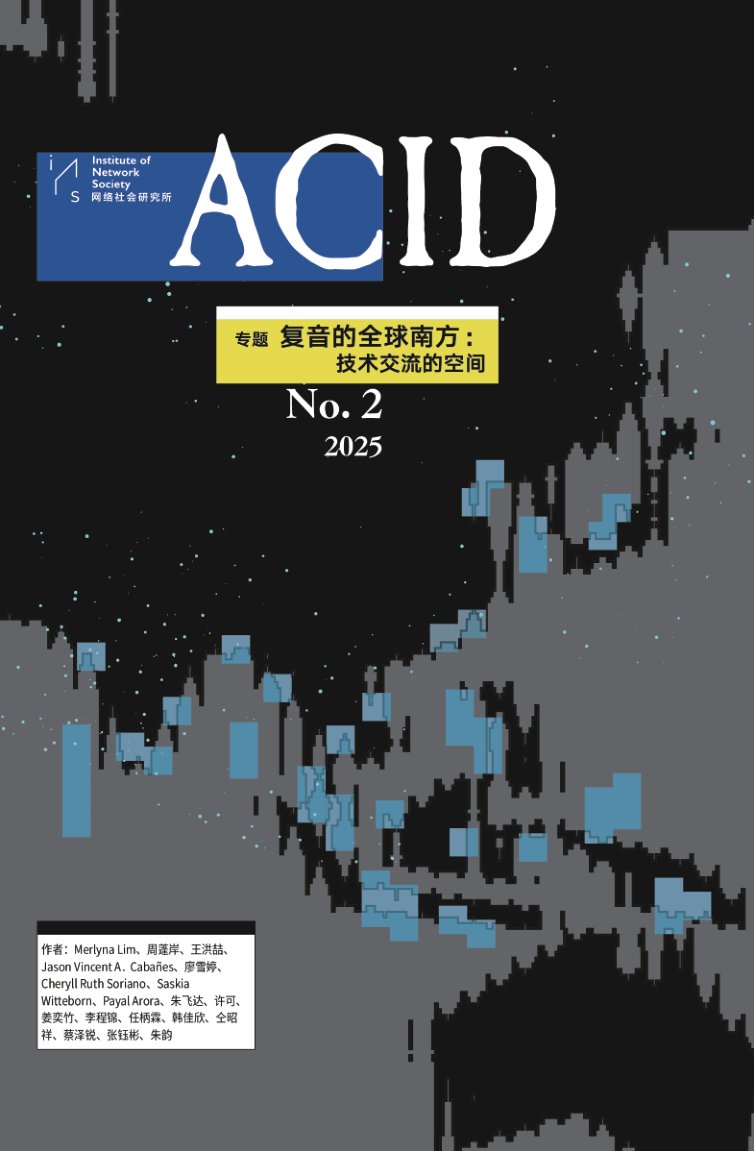
「複音的全球南方」不是地理標籤,而是一種方法論姿態。當 Balaji Srinivasan 的「網絡國家」許諾以股東制取代公民權、以私人主權剷除民主協商,當矽谷修辭把 1% 的財富集中包裝成「去中心化」,ACID 第二期把第九屆網絡社會年會選集連同一般論文放回「南方」這個複數的位置上重看。
這裡的南方,是菲律賓的平台勞動與 Web3 田野、印度的數據偏見、深圳龍華公車站的身體,是 1960 年代韓國的技術浪漫主義、1990 年代中國的山寨文化,是科技拾荒者手上被稱為「洋垃圾」的廢棄電子產品。冷戰與後冷戰、製造現場與流動親密、「社會性媒介」與「新地形」,被放在同一張地圖上。
Merlyna Lim、Jason Vincent Cabañes、Cheryll Ruth Soriano、Saskia Witteborn、Payal Arora 與來自中國、韓國、菲律賓的年輕學者一起做的,不是把全球南方包裝成抵抗的神話,而是細看「壞的數位納入」(adverse digital incorporation)與慢性貧困如何被演算法與平台重新生產。技術從來不在政治之外。問題是,我們用誰的技術,在哪一個歷史尺度上判斷。
"Polyphonic Global South" is not a geographical label but a methodological stance. When Balaji Srinivasan's "Network State" promises to replace citizenship with shareholding, and democratic deliberation with private sovereignty, when Silicon Valley rhetoric repackages the concentration of wealth in the top 1% as "decentralization," ACID No.2 places the selected papers from the 9th Annual Conference on Network Society, together with general research articles, back into the plural position called "the South."
The South here is platform labor and Web3 fieldwork in the Philippines, data bias in India, bodies at the Longhua bus terminal in Shenzhen. It is the techno-romanticism of 1960s South Korea, the shanzhai culture of 1990s China, the discarded electronics called "foreign waste" passing through the hands of tech scavengers. Cold War and post-Cold War, factory floor and mobile intimacy, "societal media" and "new terrains" are laid on a single map.
What Merlyna Lim, Jason Vincent Cabañes, Cheryll Ruth Soriano, Saskia Witteborn, Payal Arora, and emerging scholars from China, South Korea, and the Philippines do here is not to package the Global South as a myth of resistance, but to trace how "adverse digital incorporation" and chronic poverty are reproduced by algorithms and platforms. Technology has never been outside of politics. The question is: whose technology do we use, and at what historical scale do we judge.