學術引用 Citation
黃孫權(2011)。〈策展論述:跨國候鳥在台灣—勞動力特展〉。《跨國候鳥在台灣—勞動力特展專刊》。高雄:高雄市立勞工博物館。 Huang, Sun-Quan (2011). Curatorial Statement: Migrant Workers in Taiwan – Exhibition of Labor. In Migrant Workers in Taiwan – Exhibition of Labor Catalog. Kaohsiung: Kaohsiung Museum of Labor. (English translation: Zoe Yeh)
2011–2012 年於高雄市立勞工博物館策劃之「跨國候鳥在台灣—勞動力特展」開幕專刊收錄之策展論述,由策展人黃孫權(時任高雄師範大學跨領域藝術研究所專任助理教授)撰寫。中譯英者 Zoe Yeh。原刊與本檔同步收於本平台之策展頁。
展覽分七區(A–G),結合田野採集、資料分析、藝術轉化與多媒體裝置,把台灣移工的「再生產」生活(食衣住行育樂、慾望、痛苦、希望與愛情)攤在博物館空間裡,逼問台灣社會如何「看」、被誰「看」、能不能「視域融合」。藝術家陳界仁以《路徑圖》(2006)將高雄碼頭工人與全球工人運動接上。
原始刊物頁面
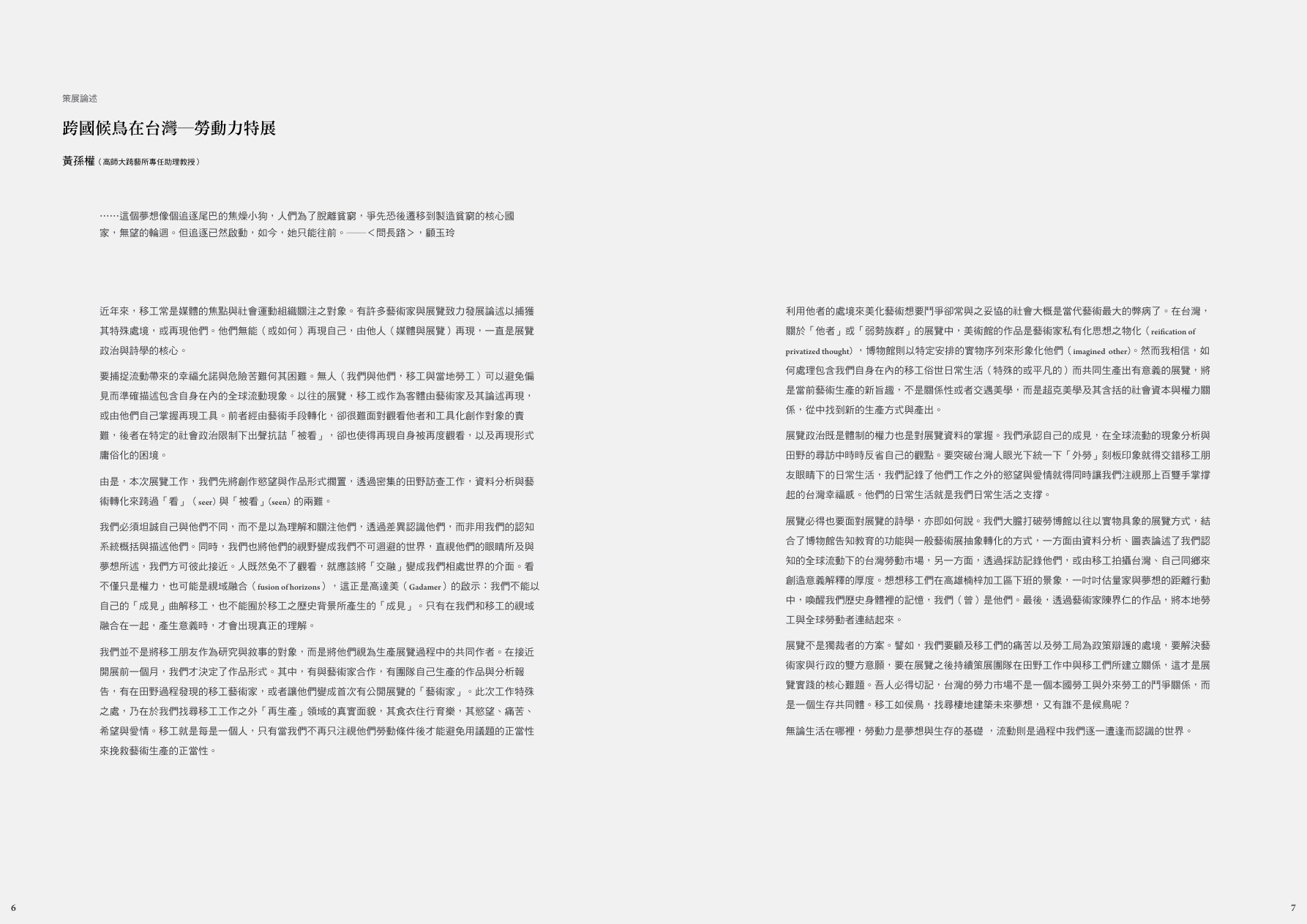
策展論述(中文原文)
……這個夢想像個追逐尾巴的焦燥小狗,人們為了脫離貧窮,爭先恐後遷移到製造貧窮的核心國家,無望的輪迴。但追逐已然啟動,如今,她只能往前。 —— 顧玉玲,〈問長路〉
近年來,移工常是媒體的焦點與社會運動組織關注之對象。有許多藝術家與展覽致力發展論述以捕獲其特殊處境,或再現他們。他們無能(或如何)再現自己,由他人(媒體與展覽)再現,一直是展覽政治與詩學的核心。
要捕捉流動帶來的幸福允諾與危險苦難何其困難。無人(我們與他們,移工與當地勞工)可以避免偏見而準確描述包含自身在內的全球流動現象。以往的展覽,移工或作為客體由藝術家及其論述再現,或由他們自己掌握再現工具。前者經由藝術手段轉化,卻很難面對觀看他者和工具化創作對象的責難,後者在特定的社會政治限制下出聲抗詰「被看」,卻也使得再現自身被再度觀看,以及再現形式庸俗化的困境。
由是,本次展覽工作,我們先將創作慾望與作品形式擱置,透過密集的田野訪查工作,資料分析與藝術轉化來跨過「看」(seer)與「被看」(seen)的兩難。
我們必須坦誠自己與他們不同,而不是以為理解和關注他們,透過差異認識他們,而非用我們的認知系統概括與描述他們。同時,我們也將他們的視野變成我們不可迴避的世界,直視他們的眼睛所及與夢想所述,我們方可彼此接近。人既然免不了觀看,就應該將「交融」變成我們相處世界的介面。看不僅只是權力,也可能是視域融合(fusion of horizons),這正是高達美(Gadamer)的啟示:我們不能以自己的「成見」曲解移工,也不能囿於移工之歷史背景所產生的「成見」。只有在我們和移工的視域融合在一起,產生意義時,才會出現真正的理解。
我們並不是將移工朋友作為研究與敘事的對象,而是將他們視為生產展覽過程中的共同作者。在接近開展前一個月,我們才決定了作品形式。其中,有與藝術家合作,有團隊自己生產的作品與分析報告,有在田野過程發現的移工藝術家,或者讓他們變成首次有公開展覽的「藝術家」。此次工作特殊之處,乃在於我們找尋移工工作之外「再生產」領域的真實面貌,其食衣住行育樂,其慾望、痛苦、希望與愛情。移工就是每是一個人,只有當我們不再只注視他們勞動條件後才能避免用議題的正當性來挽救藝術生產的正當性。
利用他者的處境來美化藝術想要鬥爭卻常與之妥協的社會大概是當代藝術最大的弊病了。在台灣,關於「他者」或「弱勢族群」的展覽中,美術館的作品是藝術家私有化思想之物化(reification of privatized thought),博物館則以特定安排的實物序列來形象化他們(imagined other)。然而我相信,如何處理包含我們自身在內的移工俗世日常生活(特殊的或平凡的)而共同生產出有意義的展覽,將是當前藝術生產的新旨趣,不是關係性或者交遇美學,而是超克美學及其含括的社會資本與權力關係,從中找到新的生產方式與產出。
展覽政治既是體制的權力也是對展覽資料的掌握。我們承認自己的成見,在全球流動的現象分析與田野的尋訪中時時反省自己的觀點。要突破台灣人眼光下統一下「外勞」刻板印象就得交錯移工朋友眼睛下的日常生活,我們記錄了他們工作之外的慾望與愛情就得同時讓我們注視那上百雙手掌撐起的台灣幸福感。他們的日常生活就是我們日常生活之支撐。
展覽必得也要面對展覽的詩學,亦即如何說。我們大膽打破勞博館以往以實物具象的展覽方式,結合了博物館告知教育的功能與一般藝術展抽象轉化的方式,一方面由資料分析、圖表論述了我們認知的全球流動下的台灣勞動市場,另一方面,透過採訪記錄他們,或由移工拍攝台灣、自己同鄉來創造意義解釋的厚度。想想移工們在高雄楠梓加工區下班的景象,一吋吋估量家與夢想的距離行動中,喚醒我們歷史身體裡的記憶,我們(曾)是他們。最後,透過藝術家陳界仁的作品,將本地勞工與全球勞動者連結起來。
展覽不是獨裁者的方案。譬如,我們要顧及移工們的痛苦以及勞工局為政策辯護的處境,要解決藝術家與行政的雙方意願,要在展覽之後持續策展團隊在田野工作中與移工們所建立關係,這才是展覽實踐的核心難題。吾人必得切記,台灣的勞力市場不是一個本國勞工與外來勞工的鬥爭關係,而是一個生存共同體。移工如候鳥,找尋棲地建築未來夢想,又有誰不是候鳥呢?
無論生活在哪裡,勞動力是夢想與生存的基礎,流動則是過程中我們逐一遭逢而認識的世界。
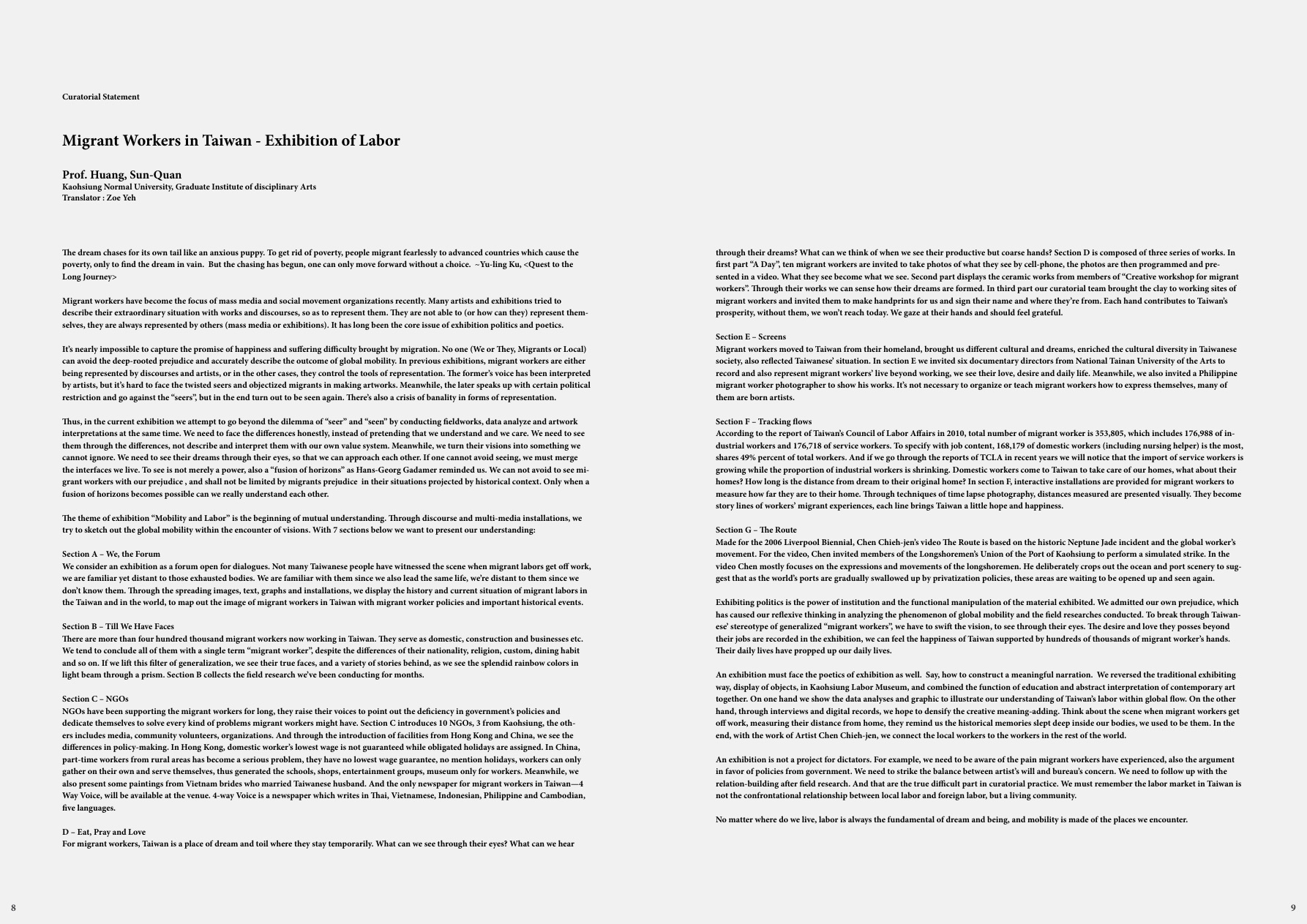
Curatorial Statement (English Original)
The dream chases for its own tail like an anxious puppy. To get rid of poverty, people migrant fearlessly to advanced countries which cause the poverty, only to find the dream in vain. But the chasing has begun, one can only move forward without a choice. — Yu-ling Ku, Quest to the Long Journey
Migrant workers have become the focus of mass media and social movement organizations recently. Many artists and exhibitions tried to describe their extraordinary situation with works and discourses, so as to represent them. They are not able to (or how can they) represent themselves, they are always represented by others (mass media or exhibitions). It has long been the core issue of exhibition politics and poetics.
It's nearly impossible to capture the promise of happiness and suffering difficulty brought by migration. No one (We or They, Migrants or Local) can avoid the deep-rooted prejudice and accurately describe the outcome of global mobility. In previous exhibitions, migrant workers are either being represented by discourses and artists, or in the other cases, they control the tools of representation. The former's voice has been interpreted by artists, but it's hard to face the twisted seers and objectized migrants in making artworks. Meanwhile, the later speaks up with certain political restriction and go against the "seers", but in the end turn out to be seen again. There's also a crisis of banality in forms of representation.
Thus, in the current exhibition we attempt to go beyond the dilemma of "seer" and "seen" by conducting fieldworks, data analyze and artwork interpretations at the same time. We need to face the differences honestly, instead of pretending that we understand and we care. We need to see them through the differences, not describe and interpret them with our own value system. Meanwhile, we turn their visions into something we cannot ignore. We need to see their dreams through their eyes, so that we can approach each other. If one cannot avoid seeing, we must merge the interfaces we live. To see is not merely a power, also a "fusion of horizons" as Hans-Georg Gadamer reminded us. We can not avoid to see migrant workers with our prejudice, and shall not be limited by migrants prejudice in their situations projected by historical context. Only when a fusion of horizons becomes possible can we really understand each other.
The theme of exhibition "Mobility and Labor" is the beginning of mutual understanding. Through discourse and multi-media installations, we try to sketch out the global mobility within the encounter of visions. With 7 sections below we want to present our understanding:
Section A — We, the Forum
We consider an exhibition as a forum open for dialogues. Not many Taiwanese people have witnessed the scene when migrant labors get off work, we are familiar yet distant to those exhausted bodies. We are familiar with them since we also lead the same life, we're distant to them since we don't know them. Through the spreading images, text, graphs and installations, we display the history and current situation of migrant labors in the Taiwan and in the world, to map out the image of migrant workers in Taiwan with migrant worker policies and important historical events.
Section B — Till We Have Faces
There are more than four hundred thousand migrant workers now working in Taiwan. They serve as domestic, construction and businesses etc. We tend to conclude all of them with a single term "migrant worker", despite the differences of their nationality, religion, custom, dining habit and so on. If we lift this filter of generalization, we see their true faces, and a variety of stories behind, as we see the splendid rainbow colors in light beam through a prism. Section B collects the field research we've been conducting for months.
Section C — NGOs
NGOs have been supporting the migrant workers for long, they raise their voices to point out the deficiency in government's policies and dedicate themselves to solve every kind of problems migrant workers might have. Section C introduces 10 NGOs, 3 from Kaohsiung, the others includes media, community volunteers, organizations. And through the introduction of facilities from Hong Kong and China, we see the differences in policy-making. In Hong Kong, domestic worker's lowest wage is not guaranteed while obligated holidays are assigned. In China, part-time workers from rural areas has become a serious problem, they have no lowest wage guarantee, no mention holidays, workers can only gather on their own and serve themselves, thus generated the schools, shops, entertainment groups, museum only for workers. Meanwhile, we also present some paintings from Vietnam brides who married Taiwanese husband. And the only newspaper for migrant workers in Taiwan—4 Way Voice, will be available at the venue. 4-way Voice is a newspaper which writes in Thai, Vietnamese, Indonesian, Philippine and Cambodian, five languages.
Section D — Eat, Pray and Love
For migrant workers, Taiwan is a place of dream and toil where they stay temporarily. What can we see through their eyes? What can we hear through their dreams? What can we think of when we see their productive but coarse hands? Section D is composed of three series of works. In first part "A Day", ten migrant workers are invited to take photos of what they see by cell-phone, the photos are then programmed and presented in a video. What they see become what we see. Second part displays the ceramic works from members of "Creative workshop for migrant workers". Through their works we can sense how their dreams are formed. In third part our curatorial team brought the clay to working sites of migrant workers and invited them to make handprints for us and sign their name and where they're from. Each hand contributes to Taiwan's prosperity, without them, we won't reach today. We gaze at their hands and should feel grateful.
Section E — Screens
Migrant workers moved to Taiwan from their homeland, brought us different cultural and dreams, enriched the cultural diversity in Taiwanese society, also reflected Taiwanese' situation. In section E we invited six documentary directors from National Tainan University of the Arts to record and also represent migrant workers' live beyond working, we see their love, desire and daily life. Meanwhile, we also invited a Philippine migrant worker photographer to show his works. It's not necessary to organize or teach migrant workers how to express themselves, many of them are born artists.
Section F — Tracking Flows
According to the report of Taiwan's Council of Labor Affairs in 2010, total number of migrant worker is 353,805, which includes 176,988 of industrial workers and 176,718 of service workers. To specify with job content, 168,179 of domestic workers (including nursing helper) is the most, shares 49% percent of total workers. And if we go through the reports of TCLA in recent years we will notice that the import of service workers is growing while the proportion of industrial workers is shrinking. Domestic workers come to Taiwan to take care of our homes, what about their homes? How long is the distance from dream to their original home? In section F, interactive installations are provided for migrant workers to measure how far they are to their home. Through techniques of time lapse photography, distances measured are presented visually. They become story lines of workers' migrant experiences, each line brings Taiwan a little hope and happiness.
Section G — The Route
Made for the 2006 Liverpool Biennial, Chen Chieh-jen's video The Route is based on the historic Neptune Jade incident and the global worker's movement. For the video, Chen invited members of the Longshoremen's Union of the Port of Kaohsiung to perform a simulated strike. In the video Chen mostly focuses on the expressions and movements of the longshoremen. He deliberately crops out the ocean and port scenery to suggest that as the world's ports are gradually swallowed up by privatization policies, these areas are waiting to be opened up and seen again.
Exhibiting politics is the power of institution and the functional manipulation of the material exhibited. We admitted our own prejudice, which has caused our reflexive thinking in analyzing the phenomenon of global mobility and the field researches conducted. To break through Taiwanese' stereotype of generalized "migrant workers", we have to swift the vision, to see through their eyes. The desire and love they posses beyond their jobs are recorded in the exhibition, we can feel the happiness of Taiwan supported by hundreds of thousands of migrant worker's hands. Their daily lives have propped up our daily lives.
An exhibition must face the poetics of exhibition as well. Say, how to construct a meaningful narration. We reversed the traditional exhibiting way, display of objects, in Kaohsiung Labor Museum, and combined the function of education and abstract interpretation of contemporary art together. On one hand we show the data analyses and graphic to illustrate our understanding of Taiwan's labor within global flow. On the other hand, through interviews and digital records, we hope to densify the creative meaning-adding. Think about the scene when migrant workers get off work, measuring their distance from home, they remind us the historical memories slept deep inside our bodies, we used to be them. In the end, with the work of Artist Chen Chieh-jen, we connect the local workers to the workers in the rest of the world.
An exhibition is not a project for dictators. For example, we need to be aware of the pain migrant workers have experienced, also the argument in favor of policies from government. We need to strike the balance between artist's will and bureau's concern. We need to follow up with the relation-building after field research. And that are the true difficult part in curatorial practice. We must remember the labor market in Taiwan is not the confrontational relationship between local labor and foreign labor, but a living community.
No matter where do we live, labor is always the fundamental of dream and being, and mobility is made of the places we encounter.
Migrant Workers in Taiwan – Exhibition of Labor Curatorial Statement Prof. Huang, Sun-Quan Kaohsiung Normal University, Graduate Institute of Interdisciplinary Arts Translator: Zoe Yeh
本體論維度 / Ontological Dimensions