學術引用 Citation
黃孫權(2025)。〈Q16|Fabric City: Open Silkware, Unbound Design〉。《Hangzhou's Bid Book for World Design Capital 2028》(杭州 2028 世界設計之都申辦書,黃孫權任計畫負責人,與劉益紅共同帶領中國美術學院師生團隊完成),頁 45–46。杭州:杭州市人民政府向世界設計組織(WDO)提交。 Huang, Sun-Quan (2025). Q16 — Fabric City: Open Silkware, Unbound Design. In Hangzhou's Bid Book for World Design Capital 2028 (Principal Investigator: Huang Sun-Quan, co-led with Liu Yihong and the China Academy of Art faculty team), pp. 45–46. Hangzhou: Hangzhou Municipal People's Government, submitted to the World Design Organization (WDO).
WDO 申辦書 Q16 要求參選城市以一個主題(theme)統合活動規劃與推廣。本文為杭州對 Q16 的完整回答(原書第 45–46 頁),由本案計畫負責人黃孫權親筆撰寫;本書整體於 2024 年 11 月至 2025 年 4 月由黃孫權與劉益紅共同帶領中國美術學院師生團隊完成。杭州於本次申辦中擊敗全球十餘座申請城市,進入最終兩座入圍候選名單。
杭州提出的主題是「Fabric City: Open Silkware, Unbound Design」。回答以四個小節展開:(一) 模組化革命的設計提案;(二) 為何是杭州,一部以編織解題的歷史;(三) 為何是 2028,未來的織機;(四) 為何叫「Open Silkware」。其論證軸線是把良渚玉琮、《營造法式》木構、明代織錦、Jacquard 提花機與大運河,重新讀為一條五千年的「可程式化設計」傳統,並以此回答觀光、生態、人口、產業四重張力。原書以英文撰寫,此處保留原文。
原始刊物頁面
Q16 — Fabric City: Open Silkware, Unbound Design
Q16 — Cities are encouraged to develop a theme around which to plan activities and promotion. Provide a detailed description of the proposed theme and how it aims to relay the proposed programme.
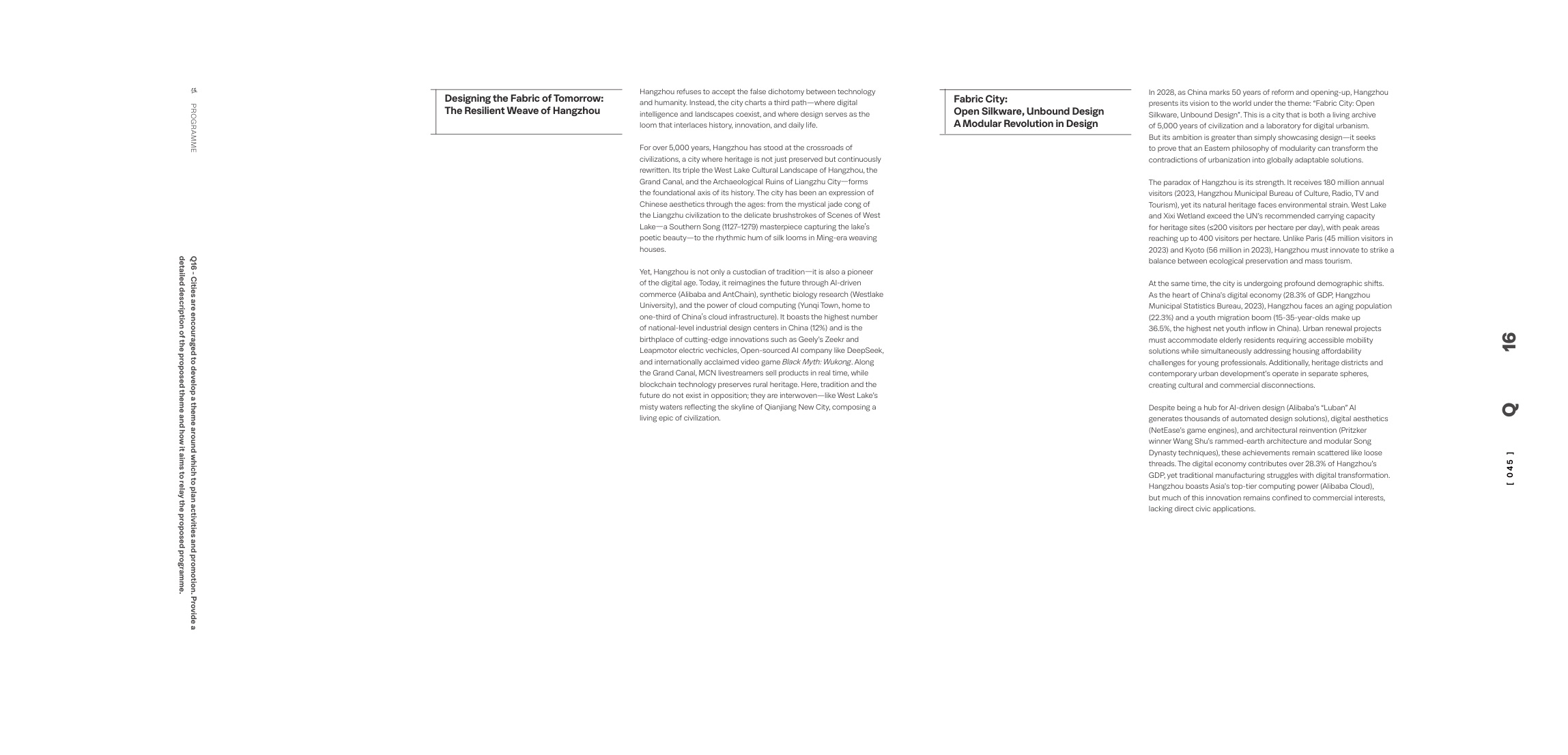
A Modular Revolution in Design — Designing the Fabric of Tomorrow: The Resilient Weave of Hangzhou
Hangzhou refuses to accept the false dichotomy between technology and humanity. Instead, the city charts a third path — where digital intelligence and landscapes coexist, and where design serves as the loom that interlaces history, innovation, and daily life.
For over 5,000 years, Hangzhou has stood at the crossroads of civilizations, a city where heritage is not just preserved but continuously rewritten. Its triple UNESCO heritage — the West Lake Cultural Landscape of Hangzhou, the Grand Canal, and the Archaeological Ruins of Liangzhu City — forms the foundational axis of its history. The city has been an expression of Chinese aesthetics through the ages: from the mystical jade cong of the Liangzhu civilization to the delicate brushstrokes of Scenes of West Lake — a Southern Song (1127–1279) masterpiece capturing the lake's poetic beauty — to the rhythmic hum of silk looms in Ming-era weaving houses.
Yet, Hangzhou is not only a custodian of tradition — it is also a pioneer of the digital age. Today, it reimagines the future through AI-driven commerce (Alibaba and AntChain), synthetic biology research (Westlake University), and the power of cloud computing (Yunqi Town, home to one-third of China's cloud infrastructure). It boasts the highest number of national-level industrial design centers in China (12%) and is the birthplace of cutting-edge innovations such as Geely's Zeekr and Leapmotor electric vehicles, open-sourced AI company DeepSeek, and the internationally acclaimed video game Black Myth: Wukong. Along the Grand Canal, MCN livestreamers sell products in real time, while blockchain technology preserves rural heritage. Here, tradition and the future do not exist in opposition; they are interwoven — like West Lake's misty waters reflecting the skyline of Qianjiang New City, composing a living epic of civilization.
In 2028, as China marks 50 years of reform and opening-up, Hangzhou presents its vision to the world under the theme: "Fabric City: Open Silkware, Unbound Design." This is a city that is both a living archive of 5,000 years of civilization and a laboratory for digital urbanism. But its ambition is greater than simply showcasing design — it seeks to prove that an Eastern philosophy of modularity can transform the contradictions of urbanization into globally adaptable solutions.
The paradox of Hangzhou is its strength. It receives 180 million annual visitors (2023, Hangzhou Municipal Bureau of Culture, Radio, TV and Tourism), yet its natural heritage faces environmental strain. West Lake and Xixi Wetland exceed the UN's recommended carrying capacity for heritage sites (≤200 visitors per hectare per day), with peak areas reaching up to 400 visitors per hectare. Unlike Paris (45 million visitors in 2023) and Kyoto (56 million in 2023), Hangzhou must innovate to strike a balance between ecological preservation and mass tourism.
At the same time, the city is undergoing profound demographic shifts. As the heart of China's digital economy (28.3% of GDP, Hangzhou Municipal Statistics Bureau, 2023), Hangzhou faces an aging population (22.3%) and a youth migration boom (15-35-year-olds make up 36.5%, the highest net youth inflow in China). Urban renewal projects must accommodate elderly residents requiring accessible mobility solutions while simultaneously addressing housing affordability challenges for young professionals. Additionally, heritage districts and contemporary urban developments operate in separate spheres, creating cultural and commercial disconnections.
Despite being a hub for AI-driven design (Alibaba's "Luban" AI generates thousands of automated design solutions), digital aesthetics (NetEase's game engines), and architectural reinvention (Pritzker winner Wang Shu's rammed-earth architecture and modular Song Dynasty techniques), these achievements remain scattered like loose threads. The digital economy contributes over 28.3% of Hangzhou's GDP, yet traditional manufacturing struggles with digital transformation. Hangzhou boasts Asia's top-tier computing power (Alibaba Cloud), but much of this innovation remains confined to commercial interests, lacking direct civic applications.
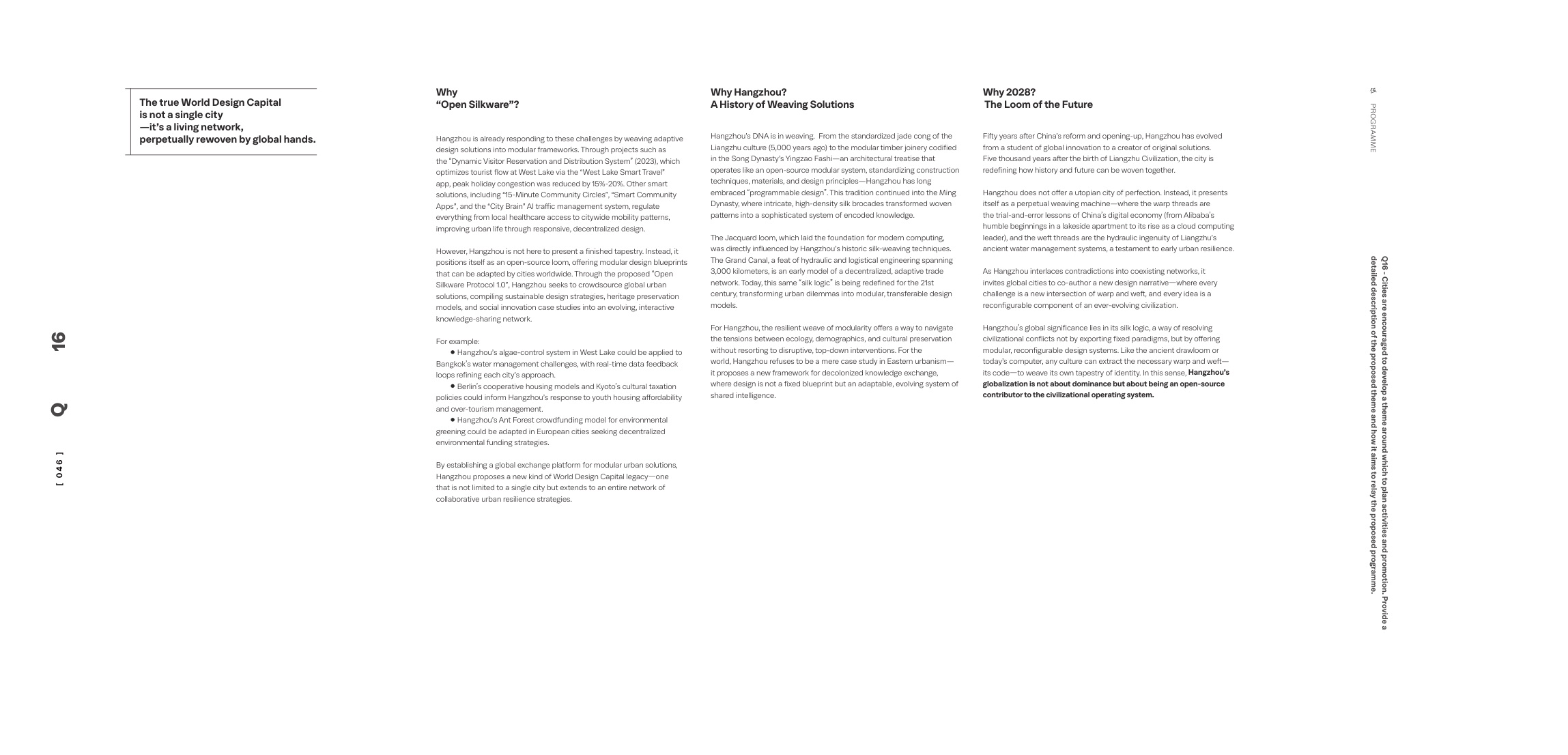
Why Hangzhou? — A History of Weaving Solutions
Hangzhou's DNA is in weaving. From the standardized jade cong of the Liangzhu culture (5,000 years ago) to the modular timber joinery codified in the Song Dynasty's Yingzao Fashi — an architectural treatise that operates like an open-source modular system, standardizing construction techniques, materials, and design principles — Hangzhou has long embraced "programmable design." This tradition continued into the Ming Dynasty, where intricate, high-density silk brocades transformed woven patterns into a sophisticated system of encoded knowledge.
The Jacquard loom, which laid the foundation for modern computing, was directly influenced by Hangzhou's historic silk-weaving techniques. The Grand Canal, a feat of hydraulic and logistical engineering spanning 3,000 kilometers, is an early model of a decentralized, adaptive trade network. Today, this same "silk logic" is being redefined for the 21st century, transforming urban dilemmas into modular, transferable design models.
For Hangzhou, the resilient weave of modularity offers a way to navigate the tensions between ecology, demographics, and cultural preservation without resorting to disruptive, top-down interventions. For the world, Hangzhou refuses to be a mere case study in Eastern urbanism — it proposes a new framework for decolonized knowledge exchange, where design is not a fixed blueprint but an adaptable, evolving system of shared intelligence.
Why 2028? — The Loom of the Future
Fifty years after China's reform and opening-up, Hangzhou has evolved from a student of global innovation to a creator of original solutions. Five thousand years after the birth of Liangzhu Civilization, the city is redefining how history and future can be woven together.
Hangzhou does not offer a utopian city of perfection. Instead, it presents itself as a perpetual weaving machine — where the warp threads are the trial-and-error lessons of China's digital economy (from Alibaba's humble beginnings in a lakeside apartment to its rise as a cloud computing leader), and the weft threads are the hydraulic ingenuity of Liangzhu's ancient water management systems, a testament to early urban resilience.
As Hangzhou interlaces contradictions into coexisting networks, it invites global cities to co-author a new design narrative — where every challenge is a new intersection of warp and weft, and every idea is a reconfigurable component of an ever-evolving civilization.
Hangzhou's global significance lies in its silk logic, a way of resolving civilizational conflicts not by exporting fixed paradigms, but by offering modular, reconfigurable design systems. Like the ancient drawloom or today's computer, any culture can extract the necessary warp and weft — its code — to weave its own tapestry of identity. In this sense, Hangzhou's globalization is not about dominance but about being an open-source contributor to the civilizational operating system.
Why "Open Silkware"?
Hangzhou is already responding to these challenges by weaving adaptive design solutions into modular frameworks. Through projects such as the "Dynamic Visitor Reservation and Distribution System" (2023), which optimizes tourist flow at West Lake via the "West Lake Smart Travel" app, peak holiday congestion was reduced by 15%–20%. Other smart solutions, including "15-Minute Community Circles," "Smart Community Apps," and the "City Brain" AI traffic management system, regulate everything from local healthcare access to citywide mobility patterns, improving urban life through responsive, decentralized design.
However, Hangzhou is not here to present a finished tapestry. Instead, it positions itself as an open-source loom, offering modular design blueprints that can be adapted by cities worldwide. Through the proposed "Open Silkware Protocol 1.0," Hangzhou seeks to crowdsource global urban solutions, compiling sustainable design strategies, heritage preservation models, and social innovation case studies into an evolving, interactive knowledge-sharing network.
For example:
- Hangzhou's algae-control system in West Lake could be applied to Bangkok's water management challenges, with real-time data feedback loops refining each city's approach.
- Berlin's cooperative housing models and Kyoto's cultural taxation policies could inform Hangzhou's response to youth housing affordability and over-tourism management.
- Hangzhou's Ant Forest crowdfunding model for environmental greening could be adapted in European cities seeking decentralized environmental funding strategies.
By establishing a global exchange platform for modular urban solutions, Hangzhou proposes a new kind of World Design Capital legacy — one that is not limited to a single city but extends to an entire network of collaborative urban resilience strategies.
The true World Design Capital is not a single city — it's a living network, perpetually rewoven by global hands.
本體論維度 / Ontological Dimensions