學術引用 Citation
黃孫權(2025)。〈PREFACE 導言〉。《Hangzhou's Bid Book for World Design Capital 2028》(杭州 2028 世界設計之都申辦書,黃孫權任計畫負責人,與劉益紅共同帶領中國美術學院師生團隊完成)。杭州:杭州市人民政府向世界設計組織(WDO)提交。 Huang, Sun-Quan (2025). PREFACE. In Hangzhou's Bid Book for World Design Capital 2028 (Principal Investigator: Huang Sun-Quan, co-led with Liu Yihong and the China Academy of Art faculty team). Hangzhou: Hangzhou Municipal People's Government, submitted to the World Design Organization (WDO).
2024 年 11 月至 2025 年 4 月,黃孫權任本案計畫負責人,與劉益紅共同帶領中國美術學院師生團隊,完成杭州競逐 World Design Organization (WDO)「2028 世界設計之都 (World Design Capital)」之申辦書 Hangzhou's Bid Book for World Design Capital 2028 的提案、撰寫、編輯、設計與影像製作。其中導言 (PREFACE) 與 Q16 主題章節核心問答由黃孫權親筆撰寫。杭州於本次申辦中擊敗全球十餘座申請城市,進入最終兩座入圍候選名單。
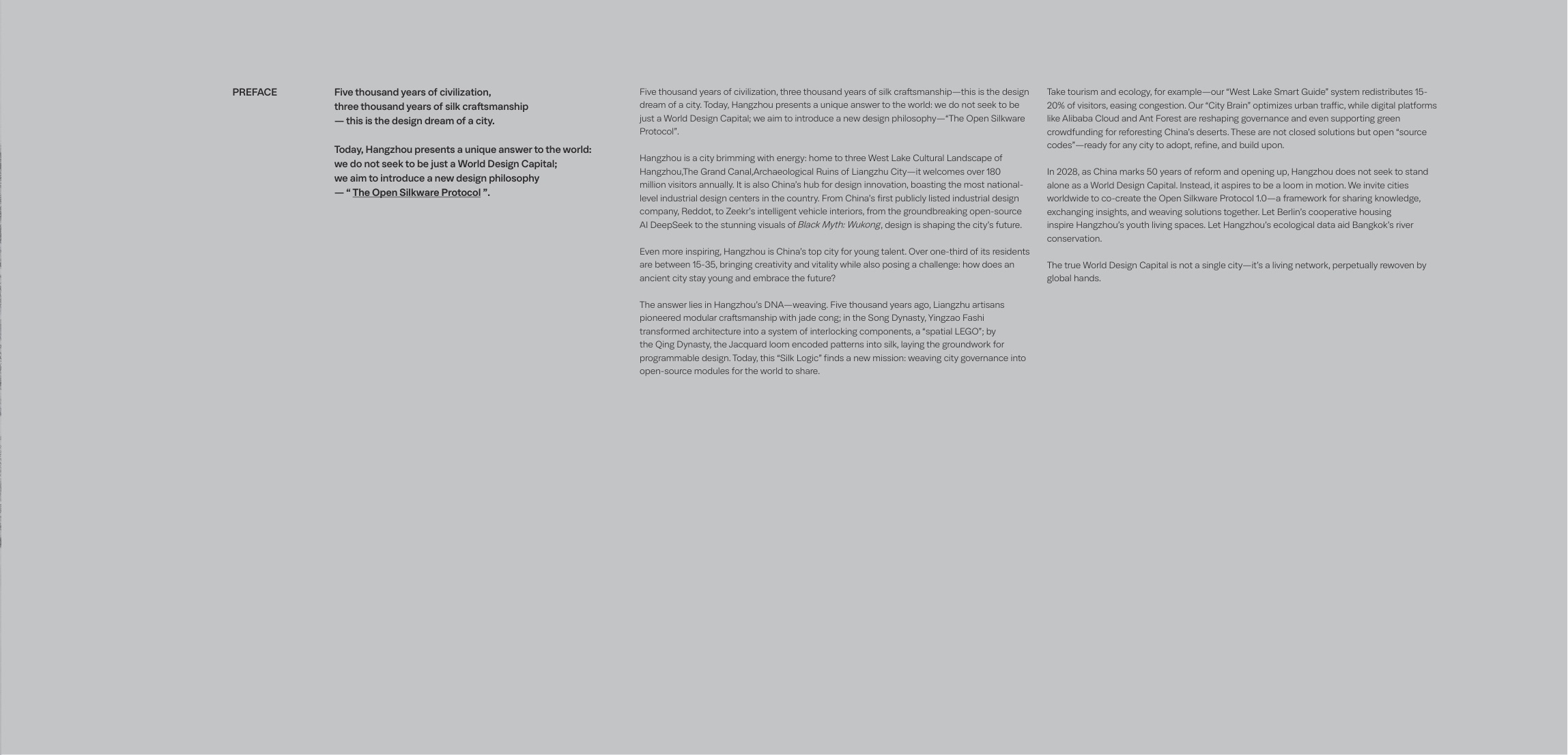
本文為申辦書首章 PREFACE 導言(原書第 5 頁),由黃孫權親筆。導言提出全書核心命題:杭州不只競逐單一頭銜,而是試圖以「Open Silkware Protocol」為名,將五千年絲綢與木構模組的工藝邏輯,重寫為一套可被全球城市共寫共修的開源治理協議。原書以英文撰寫,此處保留原文。
原始刊物頁面
PREFACE
Five thousand years of civilization, three thousand years of silk craftsmanship—this is the design dream of a city. Today, Hangzhou presents a unique answer to the world: we do not seek to be just a World Design Capital; we aim to introduce a new design philosophy—"The Open Silkware Protocol".
Hangzhou is a city brimming with energy: home to three UNESCO World Heritage Sites — the West Lake Cultural Landscape of Hangzhou, the Grand Canal, and the Archaeological Ruins of Liangzhu City — it welcomes over 180 million visitors annually. It is also China's hub for design innovation, boasting the most national-level industrial design centers in the country. From China's first publicly listed industrial design company, Reddot, to Zeekr's intelligent vehicle interiors, from the groundbreaking open-source AI DeepSeek to the stunning visuals of Black Myth: Wukong, design is shaping the city's future.
Even more inspiring, Hangzhou is China's top city for young talent. Over one-third of its residents are between 15-35, bringing creativity and vitality while also posing a challenge: how does an ancient city stay young and embrace the future?
The answer lies in Hangzhou's DNA — weaving. Five thousand years ago, Liangzhu artisans pioneered modular craftsmanship with jade cong; in the Song Dynasty, Yingzao Fashi transformed architecture into a system of interlocking components, a "spatial LEGO"; by the Qing Dynasty, the Jacquard loom encoded patterns into silk, laying the groundwork for programmable design. Today, this "Silk Logic" finds a new mission: weaving city governance into open-source modules for the world to share.
Take tourism and ecology, for example — our "West Lake Smart Guide" system redistributes 15-20% of visitors, easing congestion. Our "City Brain" optimizes urban traffic, while digital platforms like Alibaba Cloud and Ant Forest are reshaping governance and even supporting green crowdfunding for reforesting China's deserts. These are not closed solutions but open "source codes" — ready for any city to adopt, refine, and build upon.
In 2028, as China marks 50 years of reform and opening up, Hangzhou does not seek to stand alone as a World Design Capital. Instead, it aspires to be a loom in motion. We invite cities worldwide to co-create the Open Silkware Protocol 1.0 — a framework for sharing knowledge, exchanging insights, and weaving solutions together. Let Berlin's cooperative housing inspire Hangzhou's youth living spaces. Let Hangzhou's ecological data aid Bangkok's river conservation.
The true World Design Capital is not a single city — it's a living network, perpetually rewoven by global hands.
Five thousand years of civilization, three thousand years of silk craftsmanship — this is the design dream of a city.
Today, Hangzhou presents a unique answer to the world: we do not seek to be just a World Design Capital; we aim to introduce a new design philosophy — "The Open Silkware Protocol."
本體論維度 / Ontological Dimensions